The Way And The Tree Tantra
When I began to practice yoga at the age of 21 all of the spiritual ideas that had attracted me toward some spiritual path began to make sense to me. I began to see in a more clear light all of the good Christian ideas that I was exposed to with some very noble examples. I had never really taken a full "leap of faith" that defined me as some sort of Christian. I had dreams and even waking visions of some curious Christ-like figure that always had a positive message, yet I never felt obligated to say "I am a Christian", much less connect my experience and fragmentary beliefs with some religious institution. I certainly came across some pastors who were very sincere but that was always counter balanced by, well, people who would eventually vote for people like George Bush and Donald Trump because they were "good Christians."
I was also interested in Taoism and the I-Ching. I liked the idea of a responsible moral path that lead to an intuitive and natural connection with human society and a great, intelligent and mysterious divine creation, the "Tao" or "Way." Such practical ideas never tried to impose one to take a leap of faith but rather to purify, be sincere and listen so that the inner voice of creation, the Tao, can guide you on the path of the spirit. Some taoists like Lao Tzu, the author of the Tao Te Ching, synthesiezed their spiritual understanding toward harmonizing the natural order of Tao with human society, and even politics. Other Taoists like Chang Tzu were so non-conformist that they could never reconcile the corruption of the worldly order with the sublimity of Tao. Instead, Chang Tzu was a quiet mystic who lived in the mountains outside of human society, yet always interacted with humans, sharing insightful poetry and tales.
I liked reading the Taoists because their ideas synchronized with me. I was never raised in a culture with Fundamentalist Taoists that had entirely repulsed me away from their institutions with dogma and fear tactics. If one could simply understand these ideas by their poetry and literary tales then they spontaneously help one to have original, spiritual ideas. Here is my favorite Taoist tale by Chaung Tzu:
"Ting the cook was cutting meat free from the bones of an ox for Lord Wen-hui. His hands danced as his shoulders turned with the step of his foot and bending of his knee. With a shush and a hush, the blade sang following his lead, never missing a note. Ting and his blade moved as though dancing to "The Mulberry Grove," or as if conducting the "Ching-shou" with a full orchestra.
Lord Wen-Hui exclaimed, "What a joy! It's good, is it not, that such a simple craft can be so elevated?"
Ting laid aside his knife. "All I care about is the Way. I find it in my craft, that's all. When I first butchered an ox, I saw nothing but ox meat. It took three years for me to see the whole ox. Now I go out to meet it with my whole spirit and don't think only about what meets the eye. Sensing and knowing stop. The spirit goes where it will, following the natural contours, revealing large cavities, leading the blade through openings, moving onward according to actual form—yet not touching the central arteries or tendons and ligaments, much less touching bone.
"A good cook need sharpen his blade but once a year. He cuts cleanly. An awkward cook sharpens his knife every month. He chops. I've used this knife for nineteen years, carving thousands of oxen. Still the blade is as sharp as the first time it was lifted from the whetstone. At the joints there are spaces, and the blade has no thickness. Entering with no thickness where there is space, the blade may move freely where it will: there's plenty of room to move. Thus, after nineteen years, my knife remains as sharp as it was that first day.
"Even so, there are always difficult places, and when I see rough going ahead, my heart offers proper respect as I pause to look deeply into it. Then I work slowly, moving my blade with increasing subtlety until—kerplop!—meat falls apart like a crumbling clod of earth. I then raise my knife and assess my work until I'm fully satisfied. Then I give my knife a good cleaning and put it carefully away."
Lord Wen-Hui said, "That's good, indeed! Ting the cook has shown me how to find the Way to nurture life."
What I like about the practice of yoga is that it helped me understand and appreciate my past Christian connections and helped me think more freely about life like the Taoists. Of course I also came across yoga societies that repelled me in the same way as the Christian institutions but I fortunately had some very sincere yogis who were very non-conformists like Chaung Tzu who could simply speak their points of view sincerely without citing too many traditions and scriptures. I saw my yogi mentor Chidhananda as a Chaung Tzu type of figue. He was on the outskirts of human society but not unreachable for those who sought his counsel. He lived alone and meditated by the river many hours a day but also gave his time to guiding others.
Also, as a student of science, I saw yoga as a practical science. By studying science I learned about the scientific method which was very objective with practices of experimentation and peer review. Yoga was also experimental. There were theories that were based on physical and mental practices. One should not follow some leap of faith into yoga meditation but instead study a theory and try out the practices with your body as well as your inner, mental-spiritual laboratory. Of course you cannot put these practices under a microscope but at least there was the idea of experimentation and peer review. Visionary Taoists left poetry and tales to explain their experiences while yogis created a system of mind and body practices that helped people have intuitive, direct spiritual experiences. The texts are like "how to" manuals. If one follows a certain procedure then, according to yogic theory, certain results will be achieved. Shrii Aurobindu, a 20th Century yogi philosopher defined yoga as "mystical empiricism."
These texts only serve a purpose when one is beginning the path to self knowledge. Later the attachment to the forms of the path are taken from one. The infinite one wants to make us whole, not fragmented into concepts like Christian, Taoist, Yogi, etc. We must become who we are. We must see and accept the entirety of our inner being and discern the true "I" within. There is something whole and pure there and by moving inward we find that it attracts and guides us. The true "I" or Atman, as yogis call it, is so far beyond the litte "I am" of the ego. By truly seeing the complexes, ambitions and frustrations of the small ego in the eternal light of the true "I," we understand our true dignity and can never be trapped in any finite concept of self.
One´s mind flows into the infinite consciousness within and beyond nature and finds a unique spiritual expression in this interfusion of consciousness and nature. I found a deep spiritual connection with nature while meditating under trees.

Trees hold our precious earth together to prevent floods. They give us fire for wood and building shelters. Some give us fruits and food from their leaves. They work ceaselessly to convert all of the carbon we mindlessly dump into the atmosphere only to give us oxygen to live. Although it is commonly known that the leaves, fruit, root and bark of many trees have medicinal properties, their mystical properties are less known. I believe the medicinal and mystical trees are more conscious than most human beings on this planet at this time.
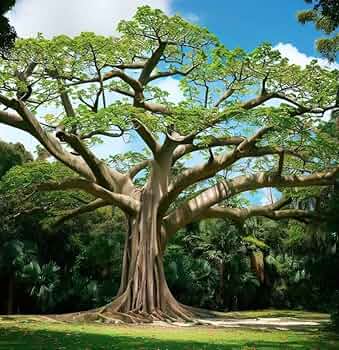
There was a Mayan yogi who always sat in meditation under the ceiba tree. Yogis in India meditate under the neem tree. Also, the Buddha attained nirvana under the Bodhi tree.
The Tree Tantra
One takes the tree as a symbol for meditation while at the same time taking actual shelter under the tree and participating with its shield of electromagnetic energy while meditating. According to Mayan mystics “nothing evil can happen while under the ceiba.” The upward force growing out of the earth helps awaken the kundalini while the downward force of converting air into mass and developing deep roots into the earth helps bring the kundalini back down. Mind must fly upward toward the spirit but also must return to the earth, at least for as long as one is on this earth. Just like the Indian Yogis, this mayan yogi said that a yogi completes his spiritual practice by bringing the kundalini back down, from the crown and back down into the spiritual heart. This gives a base for the mind mid-way along the spinal column. One can be joyfully engaged in existence here and remain in a subtle state of being while at the same time keep oneself grounded and in the body. Like the great ceiba tree, one extends high into the heavens while also rooting oneself deep into the earth. Unchecked kundalini force will eventually liberate you but it can kill your body if not careful. One gets attached to spiritual bliss and experiences but must know how to balance them out. It is better to save that intensity for when it is really time to leave all work and thereby the physical body, and never before then. Like the Upanishad says, “Desire to live 100 years while working in joyful, infinite unity.”
You should also read:
Light And Dark Tantra
Writing Light And Dark Tantra was always a balancing act. It felt very good to write about my experiences with people like Chandranath (at the far right of the photo) and other early disciples of Anandamurti. One can even feel a sense of pride about…
Continue reading...
Universal Tantra
“Brahma alone is the guru.” This saying from the Upanishads represents a very universal conception of the deity. Brahma literally means that which is great and makes others great. In other words, Brahma is the Consciousness of the Macrocosm, of the entire universe. The guru…
Continue reading...